
Phantom Limb Pain After Amputation: What Causes It — and Why Your Prosthetic Fit Matters
By Bob Manfredi, CPO/LPO | Manfredi O&P — Serving Monmouth & Ocean County, NJ since 1958

Phantom limb pain is real pain that feels like it is coming from a limb that no longer exists. It affects up to 80% of people who have undergone an amputation, typically beginning within the first six months after surgery. The pain — which can feel like burning, stabbing, cramping, or electric shock — is caused by the brain and spinal cord continuing to send and receive signals from the nerves that previously served the missing limb.
It is not psychological, and it is not permanent. Understanding what drives it is the first step toward managing it effectively — and one piece of that management is almost never discussed: the role your prosthetic fit plays.
What Causes Phantom Limb Pain?
Phantom limb pain is caused by neural changes in the brain and spinal cord after amputation. When nerves that once carried signals from the limb lose their input, the nervous system rewires — and this rewiring can generate pain signals without a physical source. The brain continues to maintain a map of the missing limb, and disruptions in that map create the sensation of pain.
After amputation, the motor and sensory cortex of the brain retains a representation of the missing limb. Over time, adjacent areas of the cortex begin to move into the space that limb previously occupied — a process called cortical reorganization. This reorganization is directly associated with phantom pain intensity. The more dramatic the reorganization, the more severe the pain tends to be.
Gate control theory offers a second mechanism: the spinal cord acts as a gating mechanism that can amplify or suppress pain signals before they reach the brain. After limb loss, the normal flow of sensory input through that gate is disrupted, and pain signals are amplified without the usual inhibitory signals to balance them. Treatments that restore sensory input — including mirror therapy and prosthetic use — work in part by re-engaging that gate.
What Does Phantom Limb Pain Feel Like?
Phantom pain is most often described as burning, stabbing, cramping, or throbbing. It is typically felt in the most distal part of the missing limb — fingers and toes most commonly. Intensity ranges from mild to severe, and episodes can be intermittent or constant. Some amputees describe it as a tightly clenched fist or a foot bent at an unnatural angle — sensations that feel completely real despite having no physical source.
Phantom pain is distinct from residual limb pain, which is pain located in the remaining part of the limb itself. Both can occur simultaneously, and both warrant clinical attention. If you are experiencing pain in the residual limb and attributing it to phantom pain — or the other way around — an evaluation by your prosthetist and care team will help clarify the source and the appropriate response.
How Long Does Phantom Limb Pain Last?
Most amputees experience phantom pain most intensely in the first six months after surgery. Research shows that while frequency and severity often decrease over time, most people continue to experience some phantom pain at two years post-amputation. Early treatment and early prosthetic use are consistently associated with better long-term outcomes.
The trajectory varies significantly between individuals. Patients who receive proactive fitting, rehabilitation, and phantom pain management early in the process report lower long-term pain burden than those who do not. Waiting is not a neutral choice — it allows cortical reorganization to proceed without interruption.
Does Wearing a Prosthesis Help With Phantom Limb Pain?
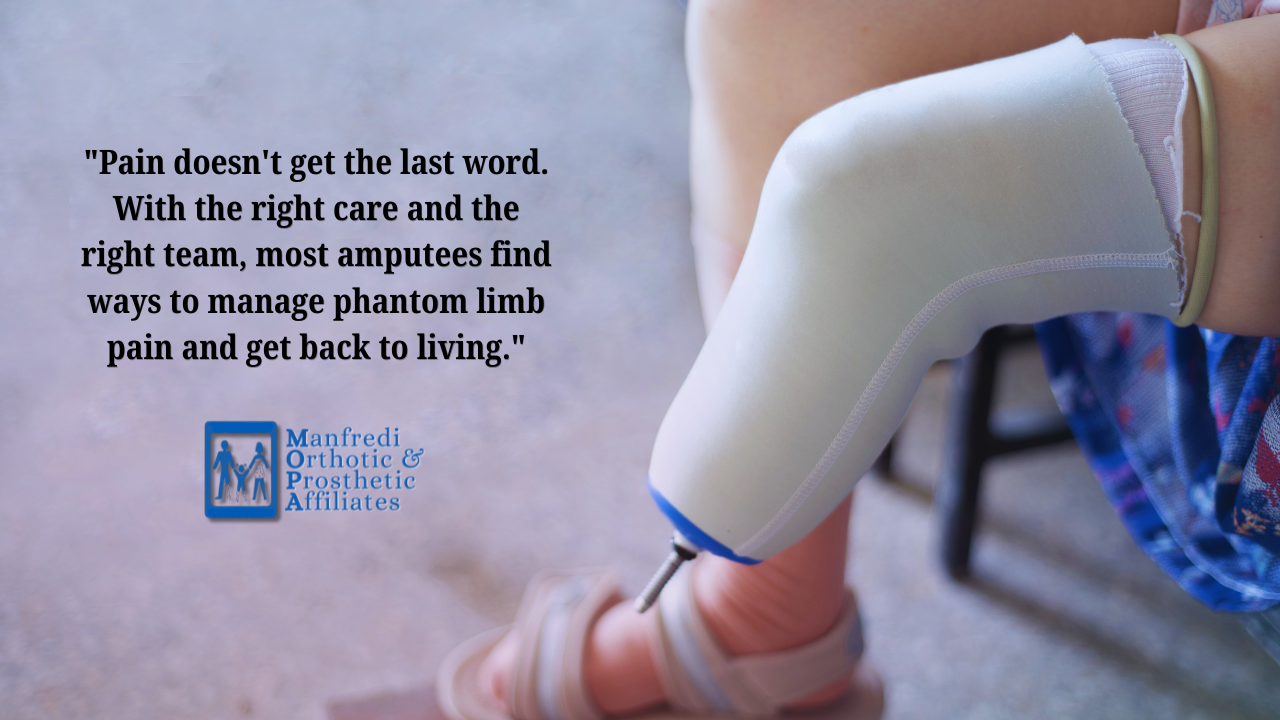
Research and clinical experience both support that prosthetic use — particularly a well-fitted prosthesis — can reduce phantom limb pain in frequency and intensity. The mechanism: a properly fitted socket provides structured sensory input to the residual limb and nervous system, supporting cortical remapping and quieting the aberrant signals that generate phantom pain.
The connection between prosthetic fit and phantom pain is one of the most under-discussed topics in amputee care. Most content patients find online focuses on medications, mirror therapy, and spinal cord stimulation — all of which have a role. What is rarely explained is the prosthetic dimension.
Here is the clinical picture: the nervous system generates phantom pain in part because it has lost the regular sensory feedback it once received from the limb. A well-fitted prosthesis partially restores that feedback loop. When a residual limb is properly loaded inside a socket — with appropriate pressure distribution, correct suspension, and matching alignment — the nervous system receives patterned, structured sensory input. Over time, this input supports the brain's process of remapping around the missing limb rather than generating pain signals in response to absent input.
A poorly fitted prosthesis, by contrast, can worsen phantom pain. A socket that loads the limb incorrectly, creates pressure points, or generates chronic discomfort can amplify nervous system sensitivity and create a feedback loop that increases phantom pain frequency.
At Manfredi O&P, phantom pain is part of every fitting assessment. If a patient reports increasing phantom pain after receiving a prosthesis, the first question we ask is about socket fit — because more often than not, fit is the lever.
What Treatments Are Available for Phantom Limb Pain?
Phantom limb pain responds to multiple treatment approaches, and the most effective plans typically combine more than one.
Mirror Therapy
Mirror therapy uses a mirror box to create a visual illusion of the missing limb moving normally. The brain receives visual feedback that the limb exists and is moving without pain — which can interrupt the pain signaling cycle. Multiple randomized controlled trials support mirror therapy as an effective short-term intervention for phantom pain, particularly in below-elbow and below-knee amputees. It can be done at home with a low-cost mirror box and a structured protocol from your physical therapist.
Graded Motor Imagery
Graded motor imagery (GMI) is a three-stage approach that begins with left/right limb recognition exercises, progresses to visualizing movement without moving, and then advances to mirror therapy. It is used for phantom pain and complex regional pain syndrome and has growing clinical evidence behind it. GMI typically requires guidance from a physical therapist trained in the protocol.
TENS and Neurostimulation
Transcutaneous electrical nerve stimulation (TENS) applies low-voltage electrical current to the skin near the residual limb to interrupt pain signals. It does not work for everyone, but it is low-risk and non-invasive enough to include in a multimodal plan. More advanced options — including peripheral nerve stimulation and spinal cord stimulation — are available for patients with severe or refractory phantom pain and are managed by pain management specialists.
Medications
Several medications are used for phantom limb pain, including gabapentin and pregabalin (anticonvulsants that dampen abnormal nerve signaling), tricyclic antidepressants, and in some cases opioids for acute severe episodes. Medication decisions are made by prescribing physicians and pain management specialists. Manfredi O&P coordinates with your prescribing team rather than directing medication decisions.
Spinal Cord Stimulation
For patients with severe phantom pain that does not respond to conservative treatment, spinal cord stimulation delivers electrical impulses directly to the spinal cord to interrupt pain signal transmission. It is an interventional procedure managed by neurosurgeons or interventional pain specialists and is generally considered after other options have been tried.
Prosthetic Fit
As described above, a well-fitted prosthesis is a direct input into phantom pain management — not a secondary consideration. If phantom pain is part of your daily experience, a fitting evaluation should be part of your treatment plan.
Psychological Support
Phantom pain has a significant psychological amplification component. Stress, anxiety, and sleep disruption all increase pain sensitivity and phantom pain frequency. Cognitive behavioral therapy (CBT) helps patients develop coping strategies that reduce the amplification of pain signals. Patients who receive psychological support alongside other treatments consistently report better overall outcomes. Your primary care physician or a psychologist familiar with chronic pain can make a referral.
When Should You Talk to Your Prosthetist About Phantom Pain?
If any of the following apply, bring it up at your next appointment — or call to schedule one:
Phantom pain is worsening since you started wearing a prosthesis
Your prosthesis causes discomfort or pressure points in the residual limb
You have never had a specific conversation with your prosthetist about phantom pain
Your current pain management plan does not include a prosthetic assessment
Phantom pain that worsens with prosthetic use is almost always a fitting issue — not an indication that the prosthesis is wrong for you. The solution is typically a socket adjustment, a different suspension system, or a different liner. Removing the prosthesis from your care plan is rarely the right answer.
Frequently Asked Questions
What is phantom limb pain?
Phantom limb pain is pain that feels like it comes from a limb that has been amputated. It is caused by the brain and nervous system continuing to generate and receive signals from nerves that previously served the missing limb. It is a well-documented neurological condition affecting the majority of people who have undergone amputation.
Is phantom limb pain psychological?
No. Phantom limb pain is a neurological condition caused by changes in the brain and spinal cord after amputation. The pain is real — generated by the nervous system and experienced in the body the same way any other pain is. Psychological factors like stress and anxiety can amplify the pain, but they are not the cause of it.
Can phantom limb pain be cured?
There is no single cure, but phantom limb pain is highly manageable. Most people experience a reduction in frequency and intensity over time, particularly with early treatment and consistent prosthetic use. A multimodal approach — combining mirror therapy, proper prosthetic fit, pain management, and psychological support — produces the best long-term outcomes.
Does a prosthesis help with phantom limb pain?
Yes, a well-fitted prosthesis can directly reduce phantom limb pain. By restoring structured sensory input to the residual limb, a correct fitting helps the nervous system remap around the missing limb rather than generating pain signals in response to absent feedback. A poorly fitted prosthesis can have the opposite effect — worsening phantom pain by amplifying nervous system sensitivity.
How is phantom limb pain treated?
Treatment typically combines mirror therapy, graded motor imagery, TENS or neurostimulation, medication (managed by a prescribing physician), prosthetic fit optimization, and psychological support. Most effective plans use more than one of these approaches in coordination.
When should I tell my prosthetist about phantom pain?
At every appointment — and especially if phantom pain is worsening, your prosthesis is causing discomfort, or phantom pain has never been part of your fitting conversation. If pain increases when you wear your prosthesis, that is a signal to act on. It is almost always a fitting issue that can be corrected.
Does phantom limb pain go away on its own?
It can decrease over time for many people, but waiting without treatment is not a neutral choice. Early treatment and early prosthetic use are consistently associated with better long-term outcomes. Patients who receive proactive care in the first year post-amputation report less persistent pain at two and five years than those who do not. If you are experiencing phantom pain, addressing it now produces better outcomes than waiting.

Ready to Talk?
Phantom limb pain does not have to be a permanent fixture of life after amputation. At Manfredi O&P, we treat the fitting process as a whole-person evaluation — and phantom pain is always part of that conversation. We have been working with amputees in Monmouth and Ocean Counties since 1958, and the connection between fit and pain management has been central to our practice the entire time.
If you are dealing with phantom pain that is not improving, or a prosthesis that is causing discomfort, we want to hear from you.
Call us at (732) 380-0366 or use the contact form at ManfrediOandP.com.
Sources1. Amputee Coalition — Phantom Limb Pain: https://www.amputee-coalition.org/resources/phantom-limb-pain/2. Cleveland Clinic — Phantom Pain: https://my.clevelandclinic.org/health/diseases/12455-phantom-pain3. Flor H, et al. "Phantom-limb pain as a perceptual correlate of cortical reorganization following arm amputation." Nature. 1995. https://pubmed.ncbi.nlm.nih.gov/7651119/