
Below-Knee Prosthetic Types: Suspension Systems, Components, and How to Know Which Is Right for You
By Bob Manfredi, CPO/LPO | Manfredi O&P — Serving Monmouth & Ocean County, NJ since 1958
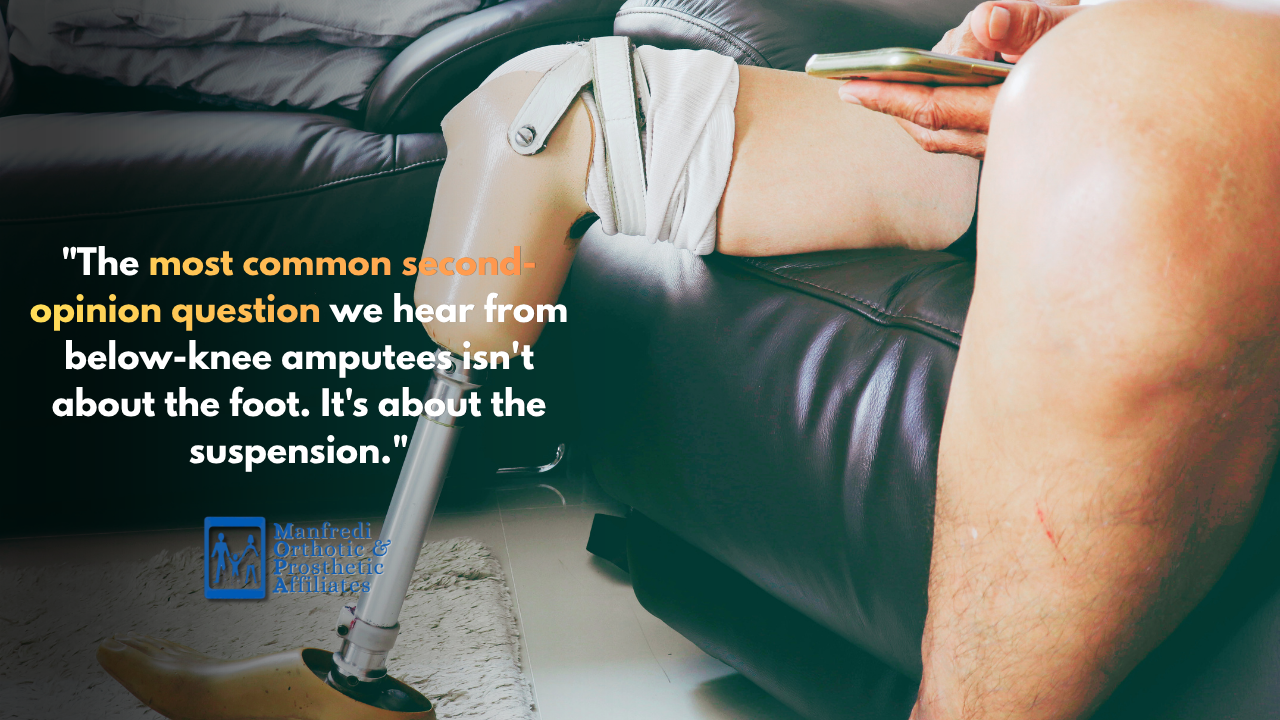
Most people receiving their first transtibial prosthesis leave their initial fitting having been offered one option. Sometimes that option is right. Often it is not — because below-knee prosthetics are not a category with a single correct answer. They are a set of decisions, and the decisions compound.
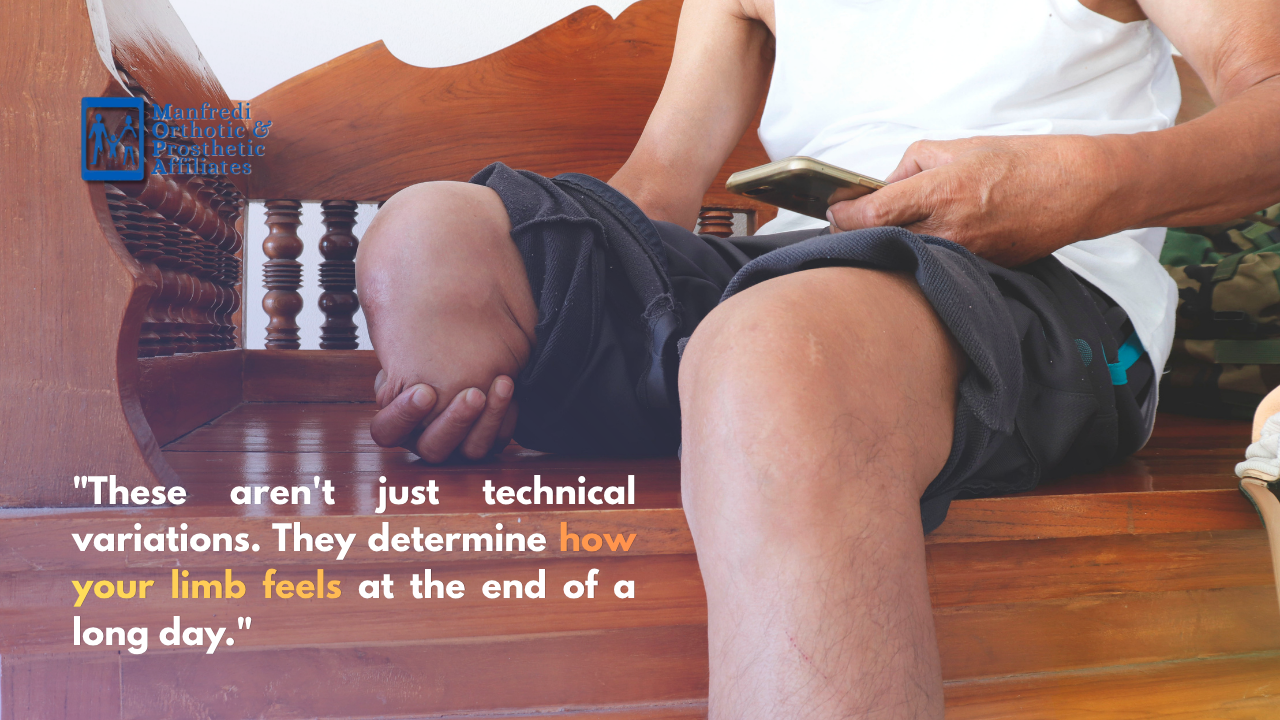
The suspension system determines how the device stays on your body and how your residual limb feels at the end of a ten-hour day. The foot component determines how much energy you get back with each step and whether you can trust the device on a slope or a wet surface. The socket is built to your anatomy specifically, but the geometry of that socket still depends on which suspension path you have chosen.
None of these decisions should be made by default. This guide covers what your options actually are.
What Is a Below-Knee (Transtibial) Prosthesis?
A below-knee prosthesis replaces limb function below the knee joint following transtibial amputation. It has three primary components: the socket, which is the custom-fit interface between your residual limb and the device; the suspension system, which determines how the socket stays on the residual limb; and the prosthetic foot and ankle, the terminal component that contacts the ground. Each of these components can vary significantly — and the combination that is right for you should reflect your activity level, your goals, your anatomy, and your insurance coverage. Not the path of least resistance.
Below-Knee Prosthetic Suspension Systems
There are five suspension systems in current clinical practice for transtibial prosthetics. Each loads the residual limb differently, each has a different performance ceiling, and each is appropriate for a different range of activity levels and anatomical presentations.
Pin Lock Suspension
The most common entry-level system. A pin at the base of the liner clicks into a locking mechanism in the socket, creating a mechanical connection. Pin lock is reliable, low-maintenance, and relatively easy to put on and take off — which matters for new users building a daily routine with a prosthesis.
The limitation is pistoning: micro-movement between the residual limb and the socket during the gait cycle. That movement is manageable at moderate activity levels, but it becomes a meaningful performance problem for higher-step-count users. Pin lock is appropriate for K2 to K3 activity levels and moderate daily use. For most patients, it is the right starting point. For many patients, it is not where they should stay.
Suction Suspension
Suction suspension creates a negative pressure seal between the liner and socket without a mechanical lock. The result is better proprioception — your nervous system reads the ground through the device more accurately — and significantly less pistoning than pin lock.
The tradeoff: suction requires a more precise socket fit, and it demands more donning skill. Getting the seal right takes practice. For K3 patients with higher daily step counts and a commitment to learning the system, the performance difference over pin lock is real and worth the additional skill investment.
Elevated Vacuum Suspension (EVS)
Elevated vacuum is the highest-performing suspension system available for below-knee users. A small pump, either electronic or mechanical, actively evacuates air from the socket chamber and maintains a continuous negative pressure seal throughout the gait cycle.
The clinical benefits are meaningful. Near-zero pistoning. Improved proprioceptive feedback. Better circulation in the residual limb during activity. Measurably better performance under load, on uneven terrain, and over long distances. For K3 to K4 active users — those returning to demanding physical work, sport, or extended outdoor activity — elevated vacuum is the system that matches their life.
Cost is higher, and insurance authorization requires documented K-level and medical necessity. That documentation process is part of what your prosthetist handles on your behalf. The system should not be ruled out because the paperwork exists. If it is clinically appropriate, it is worth pursuing.
Seal-In Liner Systems
Seal-in liners have integrated sealing rings that create a suction-like interface without a mechanical pump. Performance sits between standard suction and elevated vacuum — better than pin lock, simpler to maintain than EVS. For moderately active users who want improved suspension without the cost or mechanical complexity of elevated vacuum, seal-in is often the system that gets overlooked in the initial options conversation.
It should not be.
Lanyard Suspension
A strap-based system. Less common in current practice, and for good reason — it is lower-performing than any of the above in most scenarios. It is appropriate when other systems are not viable: very short residual limbs where liner-based systems cannot seal, or skin conditions that prevent standard liner use. Your prosthetist will flag when lanyard is the right call.
Prosthetic Foot and Ankle Components
Suspension gets most of the attention in these conversations. Foot selection is equally important — and equally variable.
SACH Foot (Solid Ankle Cushion Heel)
The most basic dynamic foot: a solid structure with a cushioned heel and minimal energy return. Appropriate for K1 to K2 users whose mobility goals are limited and for whom simplicity and durability outweigh performance. Lower cost, fewer moving parts.
Dynamic Response and Energy-Return Feet
Carbon fiber keeled feet store energy through the loading phase of the gait cycle and return it at push-off. The higher your activity level, the more energy return your foot should be designed to provide. This category spans K2 through K4 users and includes a wide range of stiffness profiles — the right stiffness depends on your body weight, walking speed, and terrain. A foot tuned for a 150-pound person walking at a moderate pace is not the same foot that works for a 220-pound person who walks four miles a day on mixed surfaces.
Microprocessor Ankle Units
Microprocessor ankles provide dynamic dorsiflexion and plantarflexion control based on gait sensors embedded in the unit. For K3 to K4 users who regularly navigate stairs, inclines, and uneven ground, a microprocessor ankle reduces compensatory movement patterns and lowers the energy cost of ambulation on variable terrain. Current carbon fiber designs are significantly lighter than earlier generations of these units.
Activity-Specific Feet
Running blades, waterproof feet for beach or pool use, high-heel feet for specific footwear. These are supplemental options — not a first prosthetic, but an addition once daily use is established and an active patient wants a device built for a specific context. The conversation about activity-specific feet starts at the fitting table, not after the fact.
How Manfredi O&P Decides Which Option Is Right for a Patient
The fitting decision at Manfredi O&P is based on five inputs: Medicare K-level functional classification, documented activity goals, residual limb anatomy, insurance coverage, and the patient's life as they actually live it. A full options review is part of every initial fitting consultation. Not an upsell conversation. A clinical decision that affects how this device performs for you every day for the next several years.
K-level matters because insurance coverage for higher-performing systems is tied to it. A K2 patient seeking elevated vacuum suspension will need documentation establishing the medical necessity of that system for their specific activity profile. We manage the authorization process as part of the fitting. That is not a bureaucratic afterthought — it is why some patients get access to the system they need and some do not.
This should be part of every initial consultation. In our experience, it rarely is.
Frequently Asked Questions
What is the best suspension system for a below-knee prosthesis?
There is no single best system. The right suspension depends on your K-level, daily activity level, residual limb anatomy, and lifestyle. Elevated vacuum is the highest-performing option for active users. Pin lock is appropriate for moderate use. A full options review with your prosthetist is the only way to match system to patient accurately.
Is elevated vacuum worth the extra cost?
For K3 to K4 active users, elevated vacuum provides measurable performance improvements: near-zero pistoning, better proprioception, improved residual limb health during activity, and better function on difficult terrain. Whether insurance will cover it depends on your documented K-level and medical necessity. For the right patient, the clinical case for EVS is strong.
What is the K-level classification system for prosthetics?
K-levels (K0 through K4) are Medicare's functional classification system for prosthetic users. K0 indicates no functional benefit from a prosthesis. K1 is household ambulation only. K2 is limited community ambulation. K3 is unrestricted community ambulation with variable terrain. K4 is high-activity use including sport or demanding physical work. Insurance coverage for components is directly tied to K-level, and your documented K-level should reflect your actual functional potential — not a default.
Can I switch suspension systems after my initial prosthetic?
Yes. If your current system is not performing for your activity level, a suspension upgrade is a clinical option — not a start-from-scratch process. The socket may need to be rebuilt to accommodate a different suspension interface, but the change is achievable. If you were not given an options review at your initial fitting, a second opinion appointment is the right starting point.
Does insurance cover below-knee prosthetics in New Jersey?
Medicare, Medicaid, and most commercial insurance plans cover medically necessary below-knee prosthetics. Coverage levels for specific components — particularly elevated vacuum suspension and microprocessor ankle units — are tied to documented K-level and medical necessity. Prior authorization is required for higher-complexity components. Manfredi O&P manages the authorization process with your insurance provider as part of the fitting.
Ready to Talk?
At Manfredi O&P, we have been fitting below-knee prosthetics in Monmouth and Ocean Counties since 1958. If you were never given a full options review at your initial fitting — or if your current prosthetic is not performing the way you need it to — reach out. That conversation costs nothing.
Call us at (732) 380-0366 or use the contact form at ManfrediOandP.com.
Sources:
1. Amputee Coalition — Prosthetic Options for Limb Loss: https://www.amputee-coalition.org/resources/
2. Medicare Benefit Policy Manual — Chapter 15, Prosthetics: https://www.cms.gov/Regulations-and-Guidance/Guidance/Manuals/Downloads/bp102c15.pdf
3. O&P Edge — Elevated Vacuum Suspension Clinical Evidence: https://opedge.com/
