
K-Levels Explained: What Your Prosthetic Mobility Classification Means for Coverage in New Jersey
By Bob Manfredi, CPO/LPO | Manfredi O&P — Serving Monmouth & Ocean County, NJ since 1958
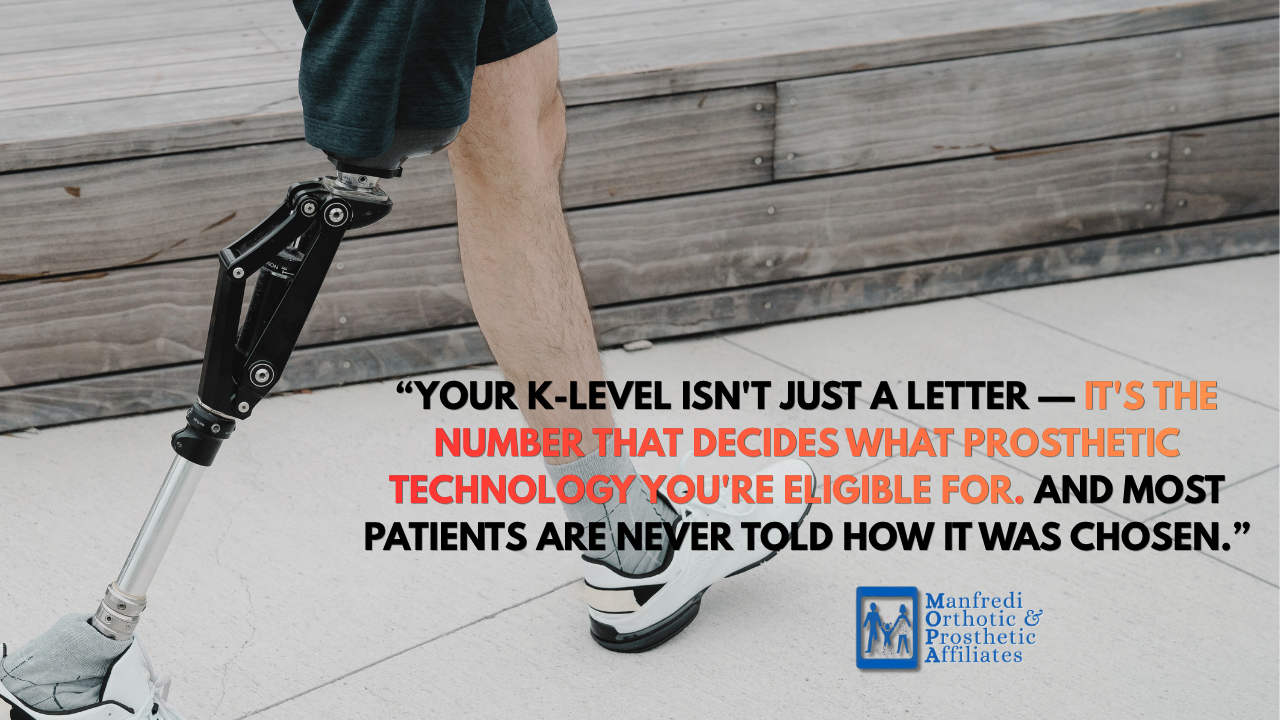
If your doctor told you that you're a "K3" after your amputation, you probably nodded — and then had no idea what that meant for your life going forward.
K-levels are one of the most consequential — and least-explained — parts of the prosthetic journey. Your classification determines which prosthetic components your insurance will cover, how much independence you can expect to regain, and in some cases, what your rehabilitation plan looks like. Here's what you actually need to know.
What Is a K-Level?
A K-level is a functional classification system used by Medicare and most major insurers to categorize a person's rehabilitation potential and ambulatory ability. The system ranges from K0 to K4, and each level corresponds to a different set of capabilities — and a different tier of prosthetic technology that insurance is willing to cover.
The classification is typically assigned by the prescribing physician in collaboration with a certified prosthetist. It's not a life sentence — K-levels can and do change as patients progress in rehabilitation.
The Five K-Levels: What Each One Means
K0 — No Rehabilitation Potential
A K0 classification means the individual does not have the strength, balance, or cognitive ability to safely use a prosthetic limb. A prosthesis is generally not indicated at this level.
K1 — Home or Limited Ambulator
A K1 patient can use a prosthesis for limited mobility — primarily transfers and walking on flat, even surfaces. K1 devices are generally basic, single-axis prosthetic feet and simple endoskeletal systems.
K2 — Low-Level Community Ambulator
A K2 patient can navigate low-level environmental barriers: a curb, a ramp, an uneven sidewalk. They walk at a single, relatively fixed pace. K2 is the most common classification for below-knee amputees who are older or have significant comorbidities. Insurance typically covers more advanced foot and suspension options at this level.
K3 — Community Ambulator with Variable Cadence
A K3 patient can vary their walking speed, navigate most environmental barriers, and engage in some vocational or therapeutic activities. This is where access to higher-performance components — dynamic-response feet, advanced suspension systems, microprocessor-controlled knees for above-knee amputees — becomes available through insurance. K3 is the target classification for most working-age adults.
K4 — High-Activity User
A K4 classification applies to active adults, athletes, and pediatric patients whose prosthetic demands exceed basic community ambulation. Running prosthetics, blade feet, and the most advanced microprocessor knees are typically covered at K4.
Not sure what your K-level should be?
Most patients leave their evaluation without a clear answer — and a miscategorized K-level can cost you access to the components you actually need. We're here to review your documentation and help you understand your options.
Who Determines Your K-Level — and When
Your K-level is typically assigned by your prescribing physician at the time of the initial prosthetic prescription. However, the certified prosthetist plays a critical role in the functional assessment that informs that decision.
This is why choosing the right prosthetist matters from day one. An experienced prosthetist who documents your functional capabilities accurately — and advocates for the appropriate classification — can make the difference between a basic prosthesis and one that genuinely matches your rehabilitation potential.
At Manfredi O&P, we work directly with referring physicians to ensure our patients are classified appropriately based on their actual abilities and goals — not the minimum that might satisfy an insurance checkbox.
K-Levels and Insurance Coverage in New Jersey
In New Jersey, prosthetic coverage is governed both by Medicare guidelines and by New Jersey's prosthetic coverage law, which requires most commercial insurance plans to cover prostheses at a medically necessary level.
Your K-level is the primary driver of what components your insurer will approve. A K2 prescription will not be approved for a microprocessor foot. A K3 patient may be denied an advanced suspension system if documentation doesn't clearly support functional need.
This makes the initial assessment and the quality of your prosthetist's clinical documentation some of the most important factors in your coverage outcome.
Can a K-Level Change?
Yes — and this is important. K-levels reflect functional potential, not a permanent ceiling. As you progress through rehabilitation, gain strength, and improve balance, a higher K-level classification may become appropriate. Conversely, a significant health change can result in a re-evaluation.
Working with a prosthetist who tracks your progress and facilitates re-evaluation when appropriate is part of comprehensive prosthetic care.
What to Do If You Think Your K-Level Is Wrong
If you feel your classification doesn't accurately reflect your capabilities or rehabilitation goals, you have options. Your prosthetist can request a functional reassessment, provide supporting documentation to your physician, and in some cases appeal a coverage decision with clinical evidence.
Don't assume your initial classification is final. At Manfredi O&P, we advocate for our patients throughout the process — from initial classification through appeals when warranted.
If you believe your K-level was assigned inaccurately, reach out to Manfredi O&P. We work directly with your physician and insurance carrier to build the clinical documentation needed for a reassessment — and we've helped New Jersey amputees secure approval for the prosthetic components they genuinely need. Call (732) 380-0366 or contact us online.
Getting the Right Classification Starts with the Right Team
Your K-level is one of the most important decisions made at the beginning of your prosthetic journey. It deserves to be made with complete, accurate clinical information — by a prosthetist who knows what you're capable of, not just what's easiest to document.
If you're starting your prosthetic journey in New Jersey, or if you're questioning whether your current classification reflects your true potential, we're here to help. Contact Manfredi O&P to schedule a consultation with our clinical team.
Ready to talk about your prosthetic coverage?
Manfredi O&P has been serving amputees in Monmouth and Ocean County since 1958. Whether you're navigating a first prosthetic evaluation, pushing back on a K-level decision, or looking for a second opinion — we're a direct call away.
📍 Eatontown & Toms River, NJ · (732) 380-0366
